How to Attract Customers to a Car Rental Business: 4 Channels That Actually Work
April 26, 2026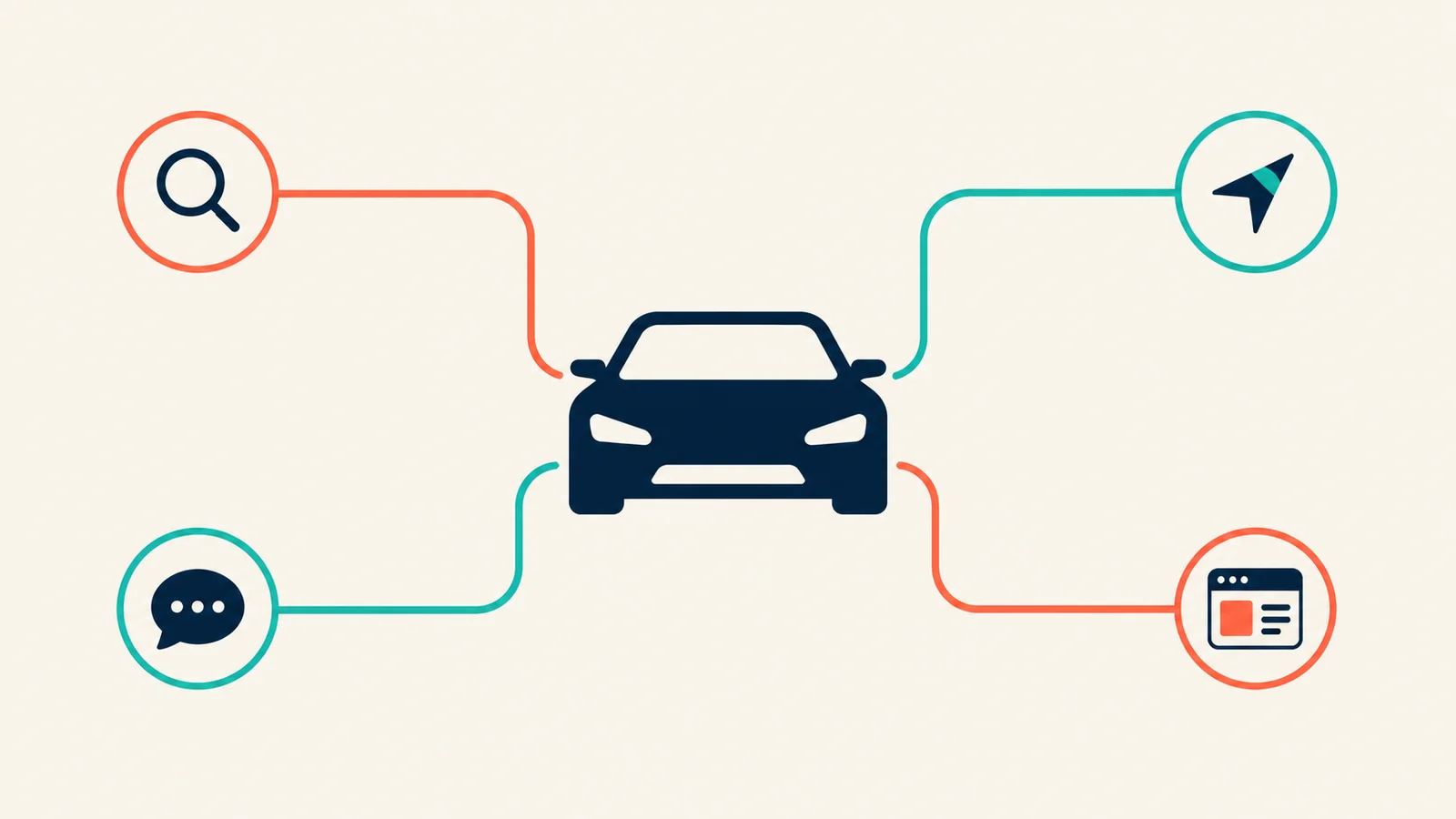
Car rental companies get customers through four channels: paid search (Google Ads), organic search (SEO), a website built to convert, and instant lead response (an AI sales agent). Aggregators bring volume but take a commission on every booking and own the customer relationship. A direct channel that combines these four pieces typically costs $4–6 per qualified lead in a competitive tourist market — that’s the benchmark from our own Vroom.DO case in Punta Cana and Bávaro, Dominican Republic.
This article breaks down what each channel actually does, what it costs, and how they fit together.
Why “just list on an aggregator” isn’t a strategy
Aggregators (rental marketplaces, OTAs) solve the cold-start problem — they bring traffic from day one. But every booking through them costs a commission, and the customer relationship belongs to the platform, not to you. There’s no channel of your own that compounds over time.
The alternative isn’t to abandon aggregators — it’s to build a direct channel alongside them, one that doesn’t take a cut of every deal and that you actually own. Full cost-structure comparison: aggregators vs. direct bookings.
The four channels, compared
| Channel | Speed to first booking | Typical cost | Best for |
|---|---|---|---|
| Google Ads | Days | Pay per click, ~$4–6 per qualified lead in a mid-competition market | Immediate demand — people already searching for a rental in your city |
| SEO | Months | No cost per click, but requires ongoing content and technical work | Long-term traffic that keeps compounding after you stop paying for it |
| AI sales agent (WhatsApp) | Instant, once set up | Flat monthly cost, not per-lead | Converting the traffic you already have — nights, weekends, peak season |
| Website built for conversion | One-time build | One-time cost | The foundation the other three depend on |
None of these four works in isolation. Ads without a converting site burn budget. SEO without a technical foundation doesn’t rank. And any traffic — paid or organic — that lands on a slow-to-respond business leaks bookings to whoever answers first.
1. Google Ads: capture demand that already exists
Search ads target people who are already typing “car rental in [your city]” — the highest-intent audience there is. The mechanics that make this work for car rental specifically:
- Campaign structure segmented by city and car type, not one generic campaign for everything
- Negative keywords so you’re not paying for browsers, only renters
- Conversion tracking wired to both the booking form and WhatsApp clicks
- A 14-day tuning window after launch, since campaigns need real spend data before they stabilize
Full breakdown: Google Ads for car rental. For a full cost breakdown, see how much Google Ads costs for car rental.
2. AI sales agent: answer every message, day or night
Rental demand doesn’t run on business hours. A request that comes in at 2am or on a Sunday goes to whoever replies first — and if that’s not you, it’s a competitor or an aggregator.
An AI sales agent on WhatsApp replies instantly, in the customer’s own language, collects car type, dates, and pickup location through natural conversation, and hands your team a request that’s ready to confirm. It doesn’t replace your team — it makes sure no lead goes cold before your team ever sees it.
Full breakdown: AI sales agent on WhatsApp. How it actually works, day to day: AI sales agent on WhatsApp for car rental. And step by step, from first message to confirmed request: how an AI agent processes booking requests.
3. SEO: traffic that doesn’t stop when you turn off the ads
Paid search buys attention; SEO earns it. For a multilingual, tourist-facing rental business, that means:
- A technical foundation: page speed, indexing, sitemaps, hreflang tags for each language
- Catalog and landing pages structured around commercial searches by city
- Guide content answering the informational questions tourists ask before they book — increasingly cited directly by AI search tools like ChatGPT and Perplexity, not just ranked in Google
- Schema.org markup so search engines and AI systems can parse your pricing, FAQs, and business details
Full breakdown: SEO for car rental. The three layers that make it work: SEO for car rental — ranking and AI citation. The AI-citation tactic in detail: how to build an FAQ page AI search cites, and the strategy behind it: AI search visibility for car rental.
4. A website built to convert, not just to look good
The other three channels all funnel traffic to one place. If that place doesn’t have a clear catalog, a simple booking path, and a WhatsApp button on every key page, the traffic converts nowhere.
Full breakdown: Car rental websites and landing pages. What actually drives conversion: car rental website that converts and 12 car rental website mistakes that kill conversion.
What this looked like in practice: the Vroom.DO case
Vroom.DO launched in Punta Cana and Bávaro with zero bookings and no existing brand recognition. The build included a multi-page site with two car catalogs, full technical SEO with Search Console configured, Google Ads search campaigns, and an AI sales agent handling WhatsApp in four languages (EN, ES, PT, RU) from day one.
Result: a steady flow of qualified leads at $4–6 cost per lead. Full numbers and screenshots in the Vroom.DO case study.
FAQ
How much does it cost to acquire a car rental customer? It depends on your market and competition in the ad auction. In the Dominican Republic, our benchmark is $4–6 per qualified lead through Google Ads. We estimate your specific number during a test launch, since it varies by city and season. Full breakdown of what “qualified” means and how to calculate your own number: cost per lead in car rental.
Do I need all four channels at once? No — Starter setups typically pair Google Ads with the AI sales agent on your existing site. A full website rebuild and dedicated SEO investment usually come once the paid channel proves the market.
How is this different from just paying an aggregator’s commission? An aggregator brings a customer but keeps a cut of every booking and owns that relationship going forward. A direct channel costs money to build once, then keeps generating bookings without a per-deal commission.
How fast can this launch? Google Ads and the AI sales agent typically launch in 5–7 business days. A full turnkey site adds 10–14 days. SEO content compounds over months, not days — it’s the channel you start now for the traffic you’ll have next year.
Want a plan for your specific market? Book a 15-minute call — we’ll look at your city, your current setup, and estimate a realistic cost per lead.